• Total Days - 18
• Trekking Days - 13
• Hotel in Kathmandu - 4 Nights
• Trek Grade - Moderate / Strenuous
• Altitude Maximum - 3700m
• Type of Trek - Lodge / Home stay
• Best Season - Spring / Autumn
• Walking Time - 5 to 7 hour each day
Tsum valley trek is one of the world’s remotest Himalayan Valleys in the Northern part of the Gorkha district which is the Tibetan Buddhist land lying at the edge of one of the most secluded Himalayan valleys of Nepal. Tsum Valley trek in Nepal is a recently opened trekking route in the Manaslu region of mid-western Nepal.
The Nepal government officially opened this trekking route in the year of 2008 for foreign tourists and ever since this area has been quite popular among trekkers who like to get off the ‘beaten trail’ and learn about Tibetan Buddhist culture. The local people are mostly Tibetan origin and practice Tibetan Buddhism.
Tsum Valley Trek Trails are strewn with artistic Chortens and lined with Mani / Prayer walls made of thousands of stone slabs carved with drawings of deities and inscribed with prayers.
The Tsum Valley has a long history of Buddhism. The Buddhist saint Milarepa is believed to be meditated in the caves of these mountains.
Another route is Manasalu trek or Manaslu circuit trek is the most popular trekking route of the Manaslu region and Tsum Valley is situated on the northern part of Gorkha near to Tibetan Border. The development of this sacred valley has been bypassed from the mainstream for centuries because it is located in a remote area and far from the cities. This route was restricted by the government before 2008, which is still on the dark side in comparison to other most popular trekking routes like Annapurna Circuit Trek, Annapurna Base Camp trek, Everest Base Camp Trek (Click for more..). so very few advantageous travelers have made this mysterious valley trek. In addition, there are other trekking routes and the hiking routes in the Manaslu region which are in the dark side due to lack of promotion. One can have a good opportunity to witness the typical ancient Tibetan Buddhist culture, religion, and lifestyle of the people who remain unchanged for centuries.
Furthermore, the unique culture of this valley has remained intact.
This area is still restricted to a limited number of organized groups so independent trekkers are not permitted in this region.
The sum trek is geographically spectacular and culturally fascinating.
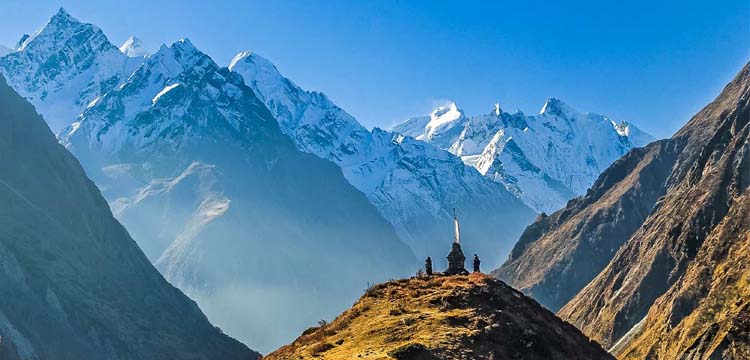
The tsum trek starts and ends to Aurughat, Gorkha, which only a few miles away from Kathmandu. During the trek, we will pass through Budhi Gandaki river, alpine forests, Glacier River, with many waterfalls and suspension bridges, through several villages, gompas ( Rachen Gompa, Mu Gompa, Dephyudonma Gompa) monasteries, mani walls, and stupas, and Milarepa’s Cave. where an individual can see an ever-extending mountain range, like Himalchuli (7,893m), Ganesh Himal (7,140m), Manaslu (8,163m), Churke Himal and the Poshyop Glacier.
Day 01: Arrival in Kathmandu – Welcome Dinner
Day 02: Visit Swoyambunath & Patan
Day 03: Drive Kathmandu to Machha Khola ( 869m) via Arughat (640m) & Soti Khola (700m)
Day 04: Trek Macha Khola to Jagat (1340m)
Day 05: Trek Jagat to Lokpa (2240m)
Day 06: Trek Lokpa to Chumling (2386m)
Day 07: Trek Chumling to Chhokhang Paro (3031m)
Day 08: Trek Chhokhang Paro to Nile (3361m)
Day 09: Trek Nile to Mu Gompa (3700m)
Day 10: Exploration Day around Mu Gompa
Day 11: Trek Mu Gompa to Lamagaon (3302m)
Day 12: Trek Lamagaon to Dumje (2460m)
Day 13: Explore the Ganesh Himal trail then trek to Ripchet (2470m)
Day 14: Trek Ripchet to Philim (1570m)
Day 15: Trek Philim to Khorlabesi (970m)
Day 16: Trek Khorlabesi to Machha Khola and drive to Kathmandu (1334m)
Day 17: Visit Boudhnath / Pashupatinath & Bhaktapur
Day 18: Departure.
Day 01: Arrival in Kathmandu – Welcome Dinner: you will be transferred to the hotel by one of our representatives. Welcome Dinner at one of the traditional Nepali restaurants in Kathmandu.
Overnight: Hotel
Elevation: 1334m
Meal Plan: D
Day 02: Visit Swoyambunath and Patan: start our tour visiting a magnificent Buddhist stupa, Swoyambunath which is 10 minutes’ drive from Thamel followed by a visit to Patan to witness its incredible architecture from medieval period.
Swoyambunath is one of the oldest stupa of the Kathmandu Valley. It is situated on one of the highest hills in the valley. It watches over the Valley from the top of a hillock on its western side just three kilometers west of the city center. The stupa is one of the holiest Buddhist sites in Nepal and its establishment is linked to the creation of the Kathmandu Valley out of a primordial lake. Swayambhu is also known as Samhengu and is recognized as a World Heritage Site. It is also one of the oldest and most glorious Buddhist shrines in the world which is said to be two thousand years. The four sides of the stupa are painted with the eyes of Lord Buddha.
Patan- the second largest town in the valley is situated to the south of Kathmandu. Patan's great building boom took place under the Mallas in the 16th, 17th and 18th centuries. Numerous temples of widely diverse styles, as well as many Buddhist monasteries, are scattered around the fascinating town. Patan is famous for its crafts and metal works which are wonderful souvenirs. We visit Patan Museum as well.
Overnight: Hotel
Day 03: Drive Kathmandu to Machha Khola (869m) via Arughat (640m) & Soti Khola (700m): following Prithivi highway up to Benighat and winding road to Dhading Besi followed by a dirt road we have a scenic drive for about 9 hours to Maccha Khola via Arughat and Soti Khola by a private Jeep.
Overnight: Lodge
Driving Time: 8 - 9 hours
Difference in Elevation: - 465m.
Day 04: Trek Macha Khola to Jagat (1340m): we start our adventure by crossing Machi Khola and Khorla Besi. The trail follows a forested area descending towards Dovan. Below Dovan, there is a huge rapid at Budi Gandaki. As the elevation increases, the rapids and the scenery undergoes into complete transformation.
Overnight: Lodge
Walking Time: 6 ½ hours
Difference in Elevation: + 471m
Day 05: Trek Jagat to Lokpa (2240m): start our day climbing over a rocky ridge to Salleri, and then descend to Sirdibas. The valley widens a bit as the trail continues up to Ghatta Khola. Continue upstream to a long simple hanging bridge. Climb up to Philim, a large Gurung village. Philim valley is well known for Japanese made school and police station. Walking past Philim to the north across a forest with the views of the narrowing valley we reach Chisopani and continuing our trek turning towards eastern valley which leads to Tsum valley, we trek to Lokpa.
Overnight: Lodge
Walking Time: 6 - 7 hours
Difference in Elevation: + 900m
Day 06: Trek Lokpa to Chumling (2386m): we continue our trek descending half an hour towards Lungwa khola followed by a climb for about 2 hours through the forest of Pine and Rhododendron, we reach Gumlung. Crossing the Siyar Khola, we continue to Chumling. In the afternoon, we can visit the old Chumling gompa, and the stone streets of the village.
Overnight: Lodge
Walking Time: 6 - 7 hours
Difference in Elevation: + 146m
Day 07: Trek Chumling to Chhokhang Paro (3031m): crossing over the suspension bridge, we continue our trek enjoying the view of Ganesh Himal. We trek through the Gho village to reach Chhokang Paro. Chhokang Paro offers great views of Himalchuli and Ganesh Himal.
Overnight: Lodge / Home stay
Walking Time: 5 - 6 hours
Difference in Elevation: + 645m
Day 08: Trek Chhokhang Paro to Nile (3361m): as we will be walking above 3 thousand meter now on, we should slow-down our pace and give our body to acclimatize with gaining altitude. The day begins with a climb following beautiful mani walls. The trail then passes through villages and vast cultivated fields surrounded by stone walls. At this altitude you see small juniper trees of the Himalayas, type of conifer with pendulous branches found in Nepal and Burma. We walk through the Rachen Gompa, which is also known as a Nunnery. Continuing our walk through the well managed villages Lar (micro hydro power), Phurbe and Pangdun and leaving old historic Stupa of Buddha and Chhule we trek to Nile
Overnight: Lodge / Home stay
Walking Time: 5 - 6 hours
Difference in Elevation: + 330m
Day 09: Trek Nile to Mu Gompa (3700m): a fairly short walk takes us to Mu Gompa which gives us enough time to explore the Gompa and surroundings. Mu Gompa is one of the largest Gompas in the region located on the ancient trade route of Nepal and Tibet.
Overnight: Lodge / Home stay / monastery stay
Walking Time: 3 hours
Difference in Elevation: + 645m
Day 10: Exploration Day around Mu Gompa: we will explore the old trading route of Nepal and Tibet and surroundings.
Overnight: Lodge / Home stay / monastery stay
Walking Time: 3 hours
Difference in Elevation: + 645m
Day 11: Trek Mu Gompa to Lamagaon (3302m): retracing our steps back to Nile, Chhule and Phurbe then we cross over the Shiar Khola and follow the west bank of the river to Lamagaon. If time permits, we will visit the cave of Milarepa (Piren Phu).
Overnight: Lodge / Home stay
Walking Time: 5 - 6 hours
Difference in Elevation: - 398m
Day 12: Trek Lamagaon to Dumje (2460m): continuing our descend; we retrace our steps back to Chhokang Paro and Gho then decend down to Dumje.
Overnight: Lodge / Home stay
Walking Time: 4 - 5 hours
Difference in Elevation: - 832 m
Day 13: Explore the Ganesh Himal trail then trek to Ripchet (2470m): we will explore the Ganesh Himal trail for a while then retracing our steps back to Dumje; we will then take a direct route to Ripchet.
Overnight: Lodge / Home stay
Walking Time: 5 - 6 hours
Difference in Elevation: - 832 m
Day 14: Trek Ripchet to Philim (1,570m): leaving behind the Tsum valley, we trek back to the Manalsu trail and continue to Philim, enjoying the view of the green valley and water-falls.
Overnight: Lodge
Walking Time: 6 - 7 hours
Difference in Elevation: - 900m
Day 15: Trek Philim to Khorlabesi (970m): we continue our descend via Jagat enjoying mostly downhill trek through Yaruphant, Dovan and Tatopani to Khorlabesi.
Overnight: Lodge
Walking Time: 6 - 7 hours
Difference in Elevation: - 600m
Day 16: Trek Khorlabesi to Machha Khola (869m) then drive to Kathmandu (1334m): a short and easy trek takes us back to Maccha Khola then we will hop on to our vehicle and drive back to Kathmandu.
Overnight: Lodge
Walking Time: 2 -3 hours
Driving Time: 9 hours
Difference in Elevation: + 364m
Overnight: Hotel
Day 17: Visit Boudhanath, Pashupatinath and Bhaktapur: we start our day visiting one of the biggest Buddhist stupas in the world, Boudhanath followed by the visit of a holiest Hindu temple called Pashupatinath then about an hour drive to visit an ancient city called Bhaktapur. This fascinating city reminds you the true culture and living style of medieval period.
Bouddhanath Stupa lies about 6 km east of downtown Kathmandu and it is the largest stupa in the Valley and one of the largest in the world. It presents one of the most fascinating specimens of stupa design with hundreds of prayer wheels and 108 small images of Buddha all around. Just like Swoyambhunath, this stupa has four sides with the watchful eyes of Lord Buddha. All the Buddhists throng to this stupa to take part in the sacred rituals during the Buddhist festivals.
Pashupatinath Temple is one of the holiest pilgrimage destinations for all the Hindus of the world. The temple is dedicated to Lord Shiva, one of the trinity and the guardian (patron) deity of Nepal. This is one of the oldest temples, situated on the banks of the Holy Bagmati River. It is a double–roofed golden temple with four triple silver doorways. Pashupatinath covers an area of 281 hectares, which is one of the biggest temple complexes in Nepal.
Bhaktapur- Located about 20 km east of Kathmandu in the Kathmandu Valley, Bhaktapur is known as the 'City of Devotees', the 'City of Culture', the 'Living Heritage', and 'Nepal's Cultural Gem'. It is one of the 3 royal cities in the Kathmandu Valley. We will visit four different squares in this city: Durbar Square (palace square), Tamaudi Square (public square), Pottery Square and Dattatrey Square.
Overnight: Hotel Marshyangdi www.hotelmarshyangdi.com or similar
Day 18: Transfer to the airport and departure.
| Srl. |
Description |
Qty. |
Remarks |
|
| 01 |
Day back-pack |
1 | ||
| 02 | Gore-Tex Jacket |
1 |
||
| 03 | Down Jacket |
1 |
||
| 04 | Fleece Jacket |
1 |
||
| 05 | Micro Fleece |
1 |
||
| 06 | Trekking pants(Trousers) |
2 |
||
| 07 | Hiking shoes (Boots) |
1 |
||
| 08 | Runners (sport shoes) |
1 |
||
| 09 | Trekking Socks |
3 |
||
| 10 | Rain poncho |
1 |
||
| 11 | Sun-glasses |
1 |
||
| 12 | Water bottles |
2 |
||
| 13 | Thermal underwear(long) |
1-2 |
||
| 14 | T- shirts |
2-3 |
||
| 15 | Sunscreen/lotion |
1 |
||
| 16 | Flip flop (sandal) |
1 |
||
| 17 | Towel |
1 |
||
| 18 | Hat(Baseball cap) |
1 |
||
| 19 | Pristine drops (Water purifier) |
1 |
||
| 20 | Head light/flash light |
1 |
||
| 21 | Sleeping Bag |
1 |
||
| 22 | Gloves |
1 |
||
| 23 | Wind Proof Trouser (s) |
1 |
||
| 24 | Personal medical kid |
1 |
||
| 25 | Toiletries |
1 |
||
Climate:
From the eternal snow of the high peaks to the extensive tropical lowlands, Nepal has a wide variety of climates.
Spring: March to late May: In this season, Kathmandu is in full bloom, lots of different types of flowers can be seen at this time of the year. Temperature is mild, end of the cold winter and approaching warm and hot summer. Temperatures vary between 10 ° C to 28 ° C but can rise up to 30 ° C. Between 2000 and 3000m, temperature rarely drop below 0 ° C. However, few frosts or snowfalls are possible in March above 4000 m.
The summer/monsoon period: It interrupts the majority of trekking from late June to late August. Some of the trekking regions "trans-Himalayan", Dolpo and Mustang, however, remain protected from monsoon prevailing rest of the country. They are the only channels available in Nepal in the summer.
Autumn: mid September – mid December - Perfect temperature and weather for trekking. Brings cooler days, but clear skies. Above 3000 m altitude, temperatures can drop to -10 ° C at night.
In winter: mid-December - mid-February - Nights are generally cold, dry climate, Above 3000m, temperature drop down to 0 ° C to - 15 ° C at night, the days are often sunny.


“JUST arrived back from Manaslu Trek, Nepal (this was our 5th trip to Nepal), And visit MERANGDING and ANGPANG villages […]
“I had such a great time while in Nepal. Chandra definitely made enjoyable environment for our such an extremely diverse […]