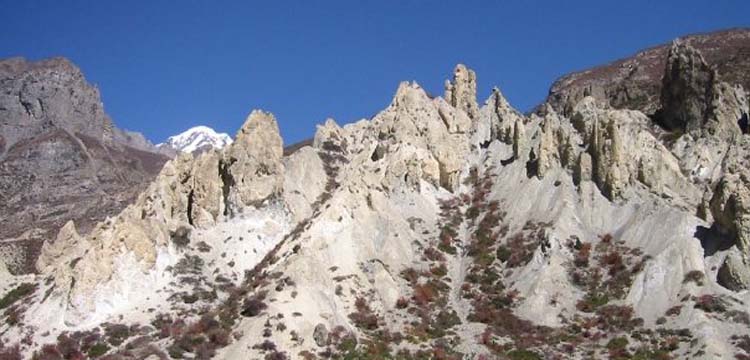
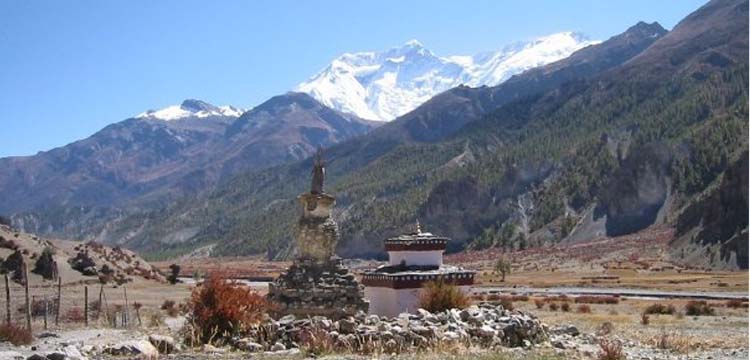
Nar Phu valley trek is one of most desired treks among the explorers as the major part of this trek goes through the hidden valley that many travelers do not even know. This trek not only takes you into the heart of the high mountains but also takes you to the hidden treasures of Tibetan culture that have been flourished in Nepali mountain. The Nar Phu valley lies in the recently opened Controlled (Restricted) trekking region that needs to have a separate special permit to enter for all the foreigners. It is one of the truly hidden valleys that has been staying off the beaten path and hiding from outside world for years.
Your adventure starts right in Kathmandu valley with the visit of Swoyambhunath, one of the oldest stupas in the Kathmandu Valley, which is situated on the top of a hill. This holy place considerably expands to include various secondary shrines, monastery, garden, and cafeteria. It is a grand and gracious structure as a whole. Next, your visit to Patan, the second largest town in the valley, will be an extraordinary experience, for it is a wonderful town with aesthetic and artistic antiquated monuments. It has several ancient temples and stupas. Every piece is a work of art and craft. More than anything, the Patan Durbar Square, a UNESCO World Heritage Site, is a pure marvel. The Square displays numerous temples and historical structures. Patan’s other attractions are Patan Museum, Uku Bahal, Sundari Chowk, and Krishna Temple.
The real adventure of Nar Phu valley trek starts at Besisahar and follows the classic route of Annapurna circuit up to Koto then the trail turns towards the northeast leaving the Manang valley behind. The trail goes through the lush pine, rhododendrons and bamboo forest and small settlements following Nar khola valley. The Nar Phu valley is open air museum of Tibetan culture so it is one of the best destinations in the Trans Himalayas for those seeking a glimpse of true Tibetan culture.
You don’t need any previous mountaineering training or technical experience for this trek. However, some vigorous hiking experience and good physical condition is very useful.
Day 01: Arrival in Kathmandu - Welcome Dinner
Day 02: Visit Swoymbunath & Patan
Day 03: Drive Kathmandu to Koto via Besisahar
Day 04: Trek Koto to Meta
Day 05: Trek Meta to Phu gaun
Day 06: Exploration Day in Phu
Day 07: Trek Phu gaun to Nar Phedi
Day 08: Trek Nar Phedi to Nar
Day 09: Trek Nar to Ngawal via Kang La
Day 10: Trek Ngawal to Manang
Day 11: Exploration Day in Manang
Day 12: Trek Manang to Chame
Day 13: Drive Chame to Kathmandu via Besisahar
Day 14: Visit Boudhanath & Bhaktapur
Day 15: Departure
Day 01: Arrival in Kathmandu: You will be transferred to the hotel by one of our representatives. Welcome dinner at one of the traditional Nepali restaurants in Kathmandu.
Overnight: Hotel
Elevation: 1334m
Day 02: Visit Swoyambunath and Patan: Start our tour visiting Swoyambunath, a magnificent Buddhist stupa located on a high hill which is just 10 minutes drive from Thamel followed by a visit of Patan, a true open air museum with its pagodas, temples, and monasteries.
Overnight: Hotel
Elevation: 1334m.
Day 03: Drive Kathmandu to Koto (2600m) via Besisahar (760m): Our adventure begins with a road journey from Kathmandu to Besisahar which takes about 5 hours followed by rough road drive to Koto (2600m) for about another 6 hours. The drive from Kathmandu to Besisahar is relatively smooth; then we leave our car in Besisahar and hop onto a local Jeep for a rough drive on a recently built dirt / rough road which take us to Koto.
Overnight: Lodge
Driving Time: 5 + 6 hours
Difference in Elevation: + 1266 m.
Day 04: Trek Koto to Meta (3560m): After completing our registration of controlled trekking area permit at the check point in Koto, we start our trek following Nar Khola through the pine forest. The lat part of the trail offers great view of the Annapurna and Lamjung Himal.
Overnight: Lodge / Home stay
Walking Time: 7 - 8 hours
Difference in Elevation: + 960m
Day 05: Trek Meta to Phu gaun (4080m): As we continue our trek, we leave the Nar Khola valley behind and start following the Phu Khola valley. The trail goes through the ruins that once were the Khampa settlements and continuing further we walk through the rocky trail to reach Phu gaun.
Overnight: Lodge / Home stay
Walking Time: 7 - 8 hours
Difference in Elevation: + 520m
Day 06: Exploration Day in Phu gaun (4080m): We can have a hike towards the Himlung Base Camp and enjoy the view of the snow capped mountains in the region or simply spend our day exploring the Phu gaun and surroundings.
Overnight: Lodge / Home stay
Day 07: Trek Phu gaun to Nar Phedi (3500m): We retrace our steps back to Nar Phedi today. It is relatively easier walk as trail descends few hundred meters and most trekkers find it easier to descend.
Overnight: Lodge / Home stay
Walking Time: 5 -6 hours
Difference in Elevation: - 580m
Day 08: Trek Nar Phedi to Nar gaun (4110m): It is comparatively short day as it takes about 2 – 3 hours to trek to Nar village but we will gain significant number of the elevation in this short trek. We start our day climbing steep terrain going through old camp sites and continue our trek walking by several Buddhist stupas, Mani walls. In the afternoon, we can explore the Nar gaun and surroundings.
Overnight: Lodge
Walking Time: 2 - 3 hours
Difference in Elevation: +610m
Day 09: Trek Nar gaun to Ngawal (3657m) via Kang la (5306m): We start our day really early in the morning as it is a long trekking day and the trail goes through a high pass so it is going to be the most strenuous day our trip. The day starts with gradual climb and gets steeper as the trek continues and gets really steep at the final part of the Kang La pass (5306m). Once we get to the top of Kang la pass, the trail descends steeply down to the Ngawal village.
Overnight: Lodge
Walking Time: 8 - 9 hours
Difference in Elevation: +453m
Day 10: Trek Ngwal to Manang (3540m): About 5 hours gentle walk to reach today's destination, Manang (3440m). Manang is a large Trans Himalayan village with rich Tibetan culture and gateway to Thorang-la pass.
Overnight: Lodge
Walking Time: 5 hours
Difference in Elevation: - 117m
Day 11: Exploration Day in Manang (3540m): We spend the day exploring the old Manang and surroundings, including Gangapurna Lake and glacier.
Overnight: Lodge
Day 12: Trek Manang to Chame (2670m): Retracing our steps back, we trek down to Chame via Lower Pisang and Dhukur Pokhari. It is mostly gradual downhill trek all the way to Chame.
Overnight: Lodge
Walking Time: 6-7 hours
Difference in Elevation: + 870m
Day 13: Drive Chame to Kathmandu (1334m) via Besisahar (760m): We start our day with a rough road drive back to Besisahar by a local Jeep which takes about 6 hour then we change our vehicle and drive back to Kathmandu which is relatively smoother. It is about 5 hours drive to Kathmandu.
Overnight: Lodge
Driving Time: 5 + 6 hours
Difference in Elevation: - 1336m
Day 14: Visit Boudhanath and Bhaktapur: Start our day with the visit of one of the biggest stupas (in terms of size) in north east of Kathmandu valley, Boudhanath followed by about an hour drive to the oldest part of the Kathmandu valley to visit an ancient city called Bhaktapur. This fascinating city reminds you the true culture and living style of medieval period.
Bouddhanath Stupa lies about 6 km east of downtown Kathmandu and it is the largest stupa in the Valley and one of the largest in the world. It presents one of the most fascinating specimens of stupa design with hundreds of prayer wheels and 108 small images of Buddha all around. Just like Swoyambhunath, this stupa has four sides with the watchful eyes of Lord Buddha. All the Buddhists throng to this stupa to take part in the sacred rituals during the Buddhist festivals.
Bhaktapur- Located about 20 km east of Kathmandu in the Kathmandu Valley, Bhaktapur is known as the 'City of Devotees', the 'City of Culture', the 'Living Heritage', and 'Nepal's Cultural Gem'. It is one of the 3 royal cities in the Kathmandu Valley. We will visit four different squares in this city: Durbar Square (palace square), Tamaudi Square (public square), Pottery Square and Dattatrey Square.
Overnight: Hotel
Meal Plan: BB
Day 15: Transfer to the airport and departure.
| Srl. | Description | Qty. | Remarks | |
| 01 | Day back-pack | 1 | ||
| 02 | Gore-Tex Jacket | 1 | ||
| 03 | Down Jacket | 1 | ||
| 04 | Fleece Jacket | 1 | ||
| 05 | Micro Fleece | 1 | ||
| 06 | Trekking pants(Trousers) | 2 | ||
| 07 | Hiking shoes (Boots) | 1 | ||
| 08 | Runners (sport shoes) | 1 | ||
| 09 | Trekking Socks | 3 | ||
| 10 | Rain poncho | 1 | ||
| 11 | Sun-glasses | 1 | ||
| 12 | Water bottles | 2 | ||
| 13 | Thermal underwear(long) | 1-2 | ||
| 14 | T- shirts | 2-3 | ||
| 15 | Sunscreen/lotion | 1 | ||
| 16 | Flip flop (sandal) | 1 | ||
| 17 | Towel | 1 | ||
| 18 | Hat(Baseball cap) | 1 | ||
| 19 | Pristine drops (Water purifier) | 1 | ||
| 20 | Head light/flash light | 1 | ||
| 21 | Sleeping Bag | 1 | ||
| 22 | Gloves | 1 | ||
| 23 | Wind Proof Trouser (s) | 1 | ||
| 24 | Personal medical kid | 1 | ||
| 25 | Toiletries | 1 | ||

Climate:
From the eternal snow of the high peaks to the extensive tropical lowlands, Nepal has a wide variety of climates.
Spring: March to late May: In this season, Kathmandu is in full bloom, lots of different types of flowers can be seen at this time of the year. Temperature is mild, end of the cold winter and approaching warm and hot summer. Temperatures vary between 10 ° C to 28 ° C but can rise up to 30 ° C. Between 2000 and 3000m, temperature rarely drop below 0 ° C. However, few frosts or snowfalls are possible in March above 4000 m.
The summer/monsoon period: It interrupts the majority of trekking from late June to late August. Some of the trekking regions "trans-Himalayan", Dolpo and Mustang, however, remain protected from monsoon prevailing rest of the country. They are the only channels available in Nepal in the summer.
Autumn: mid September – mid December - Perfect temperature and weather for trekking. Brings cooler days, but clear skies. Above 3000 m altitude, temperatures can drop to -10 ° C at night.
In winter: mid-December - mid-February - Nights are generally cold, dry climate, Above 3000m, temperature drop down to 0 ° C to - 15 ° C at night, the days are often sunny.


“JUST arrived back from Manaslu Trek, Nepal (this was our 5th trip to Nepal), And visit MERANGDING and ANGPANG villages […]
“I had such a great time while in Nepal. Chandra definitely made enjoyable environment for our such an extremely diverse […]